


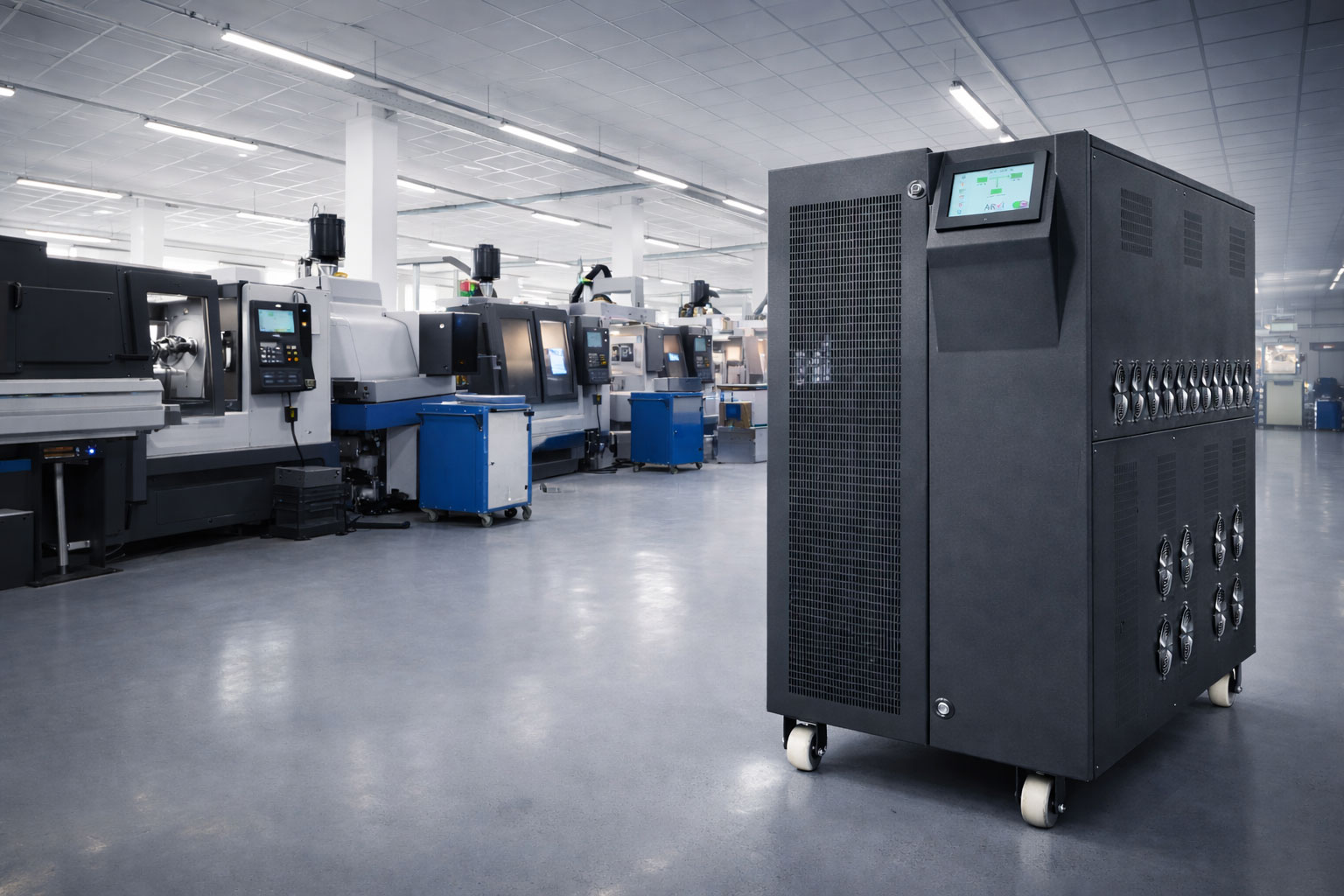
In applications such as:
- CNC-based 5-axis milling, grinding, cutting and bending machines
- Cranes, hoists and regenerative lifts
UPS systems are exposed to bidirectional power flow conditions.
Standard UPS architectures are not designed to handle:
- Repetitive regenerative cycles
- High-frequency reverse energy flow
- Dynamic load transitions
This results in:
- DC bus instability
- Nuisance tripping or bypass
- Progressive stress on both UPS and connected equipment
Therefore, load-specific UPS customisation is not optional — it is fundamental.
UPS Customisation Approach
Effective handling of regenerative loads requires:
- Evaluation of peak regenerative power
- Measurement of duration and frequency of regeneration cycles
- Analysis of load behaviour under real operating conditions
Based on this, the UPS must be engineered to:
- Absorb or control reverse energy flow
- Prevent propagation into sensitive stages
- Maintain stability during cyclic regeneration
Limitations of DBR-Based Clamping
Dynamic Braking Resistor (DBR) is widely used, but its limitations become evident under repetitive regenerative conditions.
1. Delayed Response
Regenerative energy travels through:
- Transformer
- Converter stages
- DC link filters (inductors and capacitors)
These introduce inherent latency, making DBR response reactive rather than immediate.
2. High Energy Exposure Before Activation
Since clamping is triggered at the DC bus:
- Energy accumulates before detection
- Voltage rises before corrective action
This exposes:
- UPS power electronics
- Connected load components
to repeated electrical stress.
Long-term impact includes:
- Premature failure of components
- Reduced operational life
- Increased maintenance frequency
3. DC-Side Dependency
DBR systems act only after:
- Energy reaches the DC link
This means:
- The system is already under stress before intervention
- The root issue (reverse energy at source) is not addressed
Facing similar issues in your plant?
Advanced Approach: Real-Time AC-Side Clamping
A more effective engineering approach is:
Real-Time AC-Side Regenerative Power Clamping
This method shifts control from the DC bus to the point of energy generation.
How It Works
- Regenerative power is detected at the load side
- Reverse power flow is identified instantaneously
- Clamping action is triggered in real time
- Energy is controlled before entering the UPS DC link
Key Advantages
▪ True Real-Time Response
- No delay from conversion stages
- Immediate detection and correction
▪ Clamping at Source
- Energy is controlled where it originates
- Prevents propagation through the system
▪ Eliminates DC Bus Stress
- No voltage spike accumulation
- Stable DC link operation
▪ Enhanced UPS Protection
- Reduced stress on converters and capacitors
- Improved long-term reliability
▪ Improved Load Reliability
- Load is not exposed to regenerative energy buildup
- Ensures consistent operating conditions
▪ System Stability
- Minimises oscillations
- Prevents abnormal operating behaviour
A Brief Technical Context (For System-Level Understanding)
In regenerative conditions:
- Energy flows back through the transformer
- Reaches the UPS converter
- Raises DC bus voltage
This creates a requirement for:
Fast, deterministic energy control — not delayed dissipation
Conventional approaches allow:
- Energy buildup
- Voltage rise
- Delayed correction
Whereas AC-side clamping:
- Prevents energy entry itself
Conclusion
In systems with regenerative loads:
- DBR-based solutions are inherently delayed and reactive
- They allow energy accumulation before intervention
- This leads to system stress and reduced equipment life
In contrast:
- AC-side real-time clamping is proactive and instantaneous
- It prevents instability at the source
Engineering Outcome
For applications requiring:
- High reliability under dynamic loads
- Long equipment life
- Stable UPS performance
Real-time AC-side regenerative power management is the preferred solution
If your UPS “works” but failures persist, the issue is likely in how regenerative energy is handled.
FAQ
A UPS trips during regenerative loads because energy flows back from the load into the UPS, raising the DC bus voltage beyond safe limits. Most UPS systems detect and react to this too late, causing protection circuits to trigger, leading to bypass or shutdown during braking, deceleration, or cyclic operations.
DBR (Dynamic Braking Resistor) is a method used in UPS systems to handle excess regenerative energy. When DC bus voltage rises above a threshold, a chopper circuit diverts this energy to a resistor, where it is dissipated as heat. It is a reactive, DC-side energy dissipation mechanism.
DBR is not effective for regenerative loads because it reacts only after energy reaches the DC bus, allowing voltage buildup and system stress before intervention. This delayed response exposes UPS components and connected equipment to repeated electrical stress, especially under frequent regeneration cycles in CNC machines and lifts.
AC-side clamping is a method of controlling regenerative energy at the load side before it enters the UPS system. It detects reverse power flow instantly and limits it in real time, preventing energy from reaching the DC bus and ensuring stable operation under dynamic and bidirectional load conditions.
UPS systems suitable for CNC machines and lifts must be designed for regenerative and dynamic loads. They should handle bidirectional power flow, prevent voltage spikes, and maintain waveform stability under high surge conditions. Systems with real-time AC-side control or equivalent regenerative handling capability are typically required.