


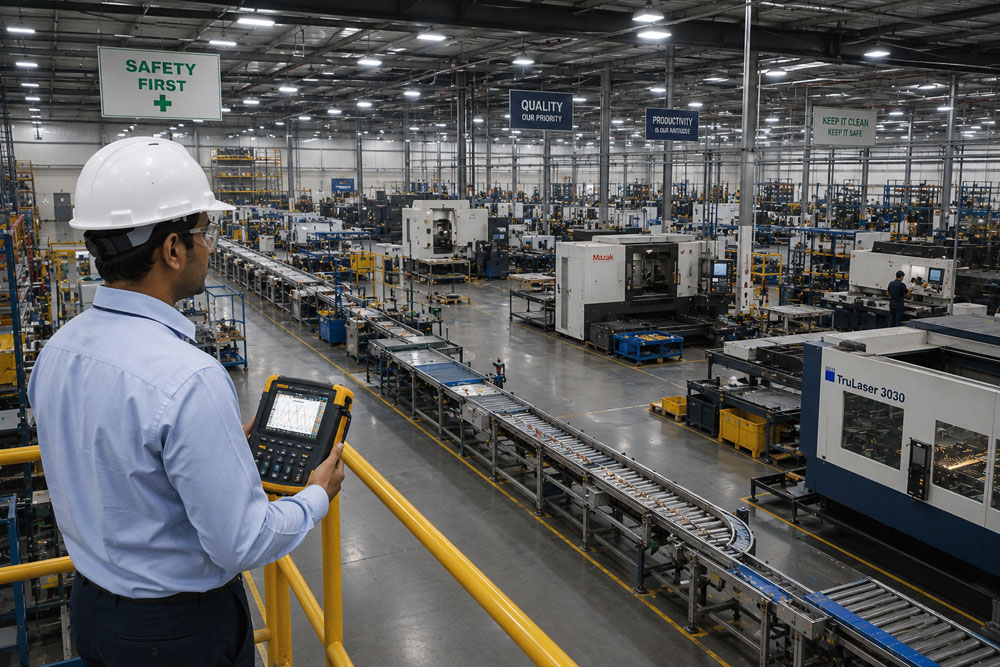
Why selecting the right application-specific UPS is essential to protecting your equipment investment
A standard industrial-grade UPS is designed to perform reliably under normal operating conditions and can also handle conventional surge and peak power demands and may save a few thousands at the point of purchase. However, under high crest-factor, repetitive peak-load applications—where the load current rises almost instantaneously from its average operating current to its peak value, with a near-vertical rate of rise on the current waveform—the demand placed on the UPS is fundamentally different.
During these extremely steep current transitions, the UPS is required to respond within microseconds while maintaining a clean and stable output waveform. A conventional industrial UPS, are not specifically engineered for this type of load behaviour, and will be unable to maintain output power integrity under these conditions. The output waveform becomes distorted during every repetitive peak-current event, and this distorted power is continuously delivered to the connected equipment. But under high-crest, repetitive peak load operations, the output power gets compromised. The UPS distorts under demand it was not engineered to handle, and that distorted power feeds continuously into the power supplies and sensitive components of the connected equipment.
The damage is not sudden. It is cumulative. The equipment fails to perform to its designed optimum, falls short of its intended product life, and the lakhs committed to the machinery and infrastructure are quietly put at risk. The equipment reaches end of life well before its designed life. The cost of ownership per year climbs. And in the end, you lose lakhs of rupees trying to save a few thousands.
This guide sets out what a load-specific UPS has to do that a standardised one does not: what happens to the output waveform during real industrial load stress, why that behaviour is permitted by international standards, and what ARVI engineered differently through DVI and Crest Power Delivery.
The evidence for it: a failure pattern with no power cut in it
The argument for application-specific engineering is not theoretical. It shows up as a recognisable failure pattern on shop floors that already have a UPS installed and working.
Industrial equipment does not draw power smoothly. Virtually all industrial machinery passes repeatedly through dynamic, non-linear operating cycles. Under normal conditions a conventional industrial UPS supports those loads reliably. The behaviour changes during high-intensity operations occurring in rapid succession, where the rate of current rise is steep (high di/dt). The load becomes sharply non-linear, load current overshoots repeatedly, and the UPS is jolted into an instantaneous energy demand it must answer within the cycle.
What plants see downstream of that:
- Machine faults with no traceable electrical root cause
- Progressive degradation of internal power supplies, capacitors, breakers and control modules
- Unplanned stoppages during production, not during outages
- Equipment reaching end of useful life well short of its designed life
There was no power cut. The UPS did not fail. The waveform did.
Which is why the three questions most industrial UPS evaluations are built on, how much backup time, how tight is the voltage regulation and what is the efficiency, cannot surface this problem. A system can score well on all three and still be permitting it at every load cycle.
What the standards actually permit
This is the part most buyers never see in a datasheet. To absorb a power jolt of this kind, the guideline recommended under international norms allows a momentary distortion in the output power waveform and a nominal dip in the output voltage, on the condition that it is corrected within the next power cycle. Standard UPS systems follow IEC and UL requirements, which permit a voltage dip of ±5% for 10ms during very high surge current events.
A conventional industrial UPS therefore allows that momentary distortion during high-intensity, rapid-cyclic load operation. It is fully compliant while doing so.
The engineering objection is not the size of any single distortion. An individual event is extremely small. The objection is the cumulative effect of millions of such repetitive electrical events across the operating life of the machine, which influences the long-term performance, reliability and service life of the connected equipment.
Compliance confirms the UPS meets a standard. It does not confirm the machine is protected.
For applications where every operating cycle demands an almost instantaneous energy response, maintaining output voltage integrity and waveform quality in each individual cycle becomes the real engineering requirement. That is the difference between a conventional industrial UPS and one specifically engineered to withstand repetitive, steep-rising current overshoots.
DVI: the topology that responds to load behaviour in real time
At the core of the ARVI HSP UPS is a proprietary technology called DVI, Dynamically Varying Impedance.
Conventional UPS systems operate with a relatively fixed output response. They are designed around an assumed load profile and hold that response as load behaviour changes.
DVI does the opposite. The HSP model continuously senses load current and dynamically varies its output impedance in real time, using a proprietary switching topology combined with specially designed magnetics.
That matters because modern industrial loads, automated manufacturing systems, regenerative drives, laser cutting machines and CNC machines, are highly non-linear. Their power demand varies continuously, creating repetitive peak loading, harmonic stress and dynamic current behaviour. A fixed output response cannot track that. A dynamically varying one can.
CPD: what DVI delivers at the output
The result of DVI is Crest Power Delivery, or CPD: the ability to maintain premium-grade power quality and a clean, undistorted output waveform even during repetitive peak demand and real process load stress.
With DVI and CPD as core capabilities, ARVI UPS systems:
- Handle high inrush current and repetitive peak demand without output voltage dip
- Prevent crest clipping and waveform distortion, keeping THD under control
- Protect machine power supplies and process controllers from harmonic stress
- Reduce unexpected shutdowns, automation failures and production downtime
CPD is not an option or an upgrade module. It is a default capability of ARVI industrial UPS platforms.
Conventional UPS vs ARVI HSP under repetitive peak load
| Conventional industrial UPS | ARVI HSP (DVI + CPD) | |
| Output waveform at peak demand | Clipped waveform with voltage dip for 10ms | Clean, undistorted waveform |
| Output voltage under surge | Nominal dip permitted, corrected next cycle | No voltage dip |
| THD during cyclic operation | Spikes during repetitive load cycles | Controlled |
| Response to changing load | Relatively fixed output response | Output impedance varies dynamically with sensed load current |
| Derating under harmonic load | Harmonic derating applied | No derating |
| Effect on connected machinery | Cumulative stress on machine power supplies, shortening component life | Load-induced distortion compensated at the output |
Because the effects of poor power quality are not immediately visible, the root cause of power supply failures, premature component degradation and unexpected downtime is routinely missed. Failures occur not only during outages, but through the slow cumulative damage of repeated exposure to a distorted waveform.
The four industrial load families that need this
Not every load creates this problem. These five do, each for a different electrical reason.
CNC and motor-driven machining. Rapid acceleration and deceleration cycles, steep current overshoot, harmonic generation from drives. Read the detailed breakdown in UPS for CNC machines.
Laser cutting systems. Extreme repetitive surge cycles, high inrush, non-linear draw feeding distortion back into the supply, with expensive laser sources and power supply modules exposed to it. See UPS for laser cutting machines.
Regenerative loads. Cranes, hoists, lifts and servo-driven machinery return energy to the system during braking and deceleration. The engineering question here is not just waveform quality but where in the system reverse energy gets controlled. See UPS for regenerative loads.
Process automation lines. Line motors, VFD-driven drives, compressors and chillers sitting on the same infrastructure as PLC, SCADA and HMI control systems, where one distorted supply can stall an entire line. See UPS for process automation.
Engineered for a 10 to 15 year operating life
ARVI UPS systems are built for 10 to 15 year operational lifecycles in real manufacturing, automated processing and factory conditions.
That figure is only meaningful alongside the power quality argument. Clean power during peak load cycles is what allows connected machinery to reach its own designed life, which is what justifies the capital investment in the machinery in the first place. A UPS that meets its standard while permitting cumulative waveform distortion protects itself. It does not protect the asset it sits in front of.
How to evaluate an industrial UPS supplier
For smaller installations a local service office is usually sufficient. For production-scale and mission-critical applications, the difference between a local factory and a local branch office becomes decisive.
The question is not whether a supplier has a Bangalore office. It is whether they have a complete factory ecosystem, spare availability, standby capability and engineering depth, available locally when your plant needs it.
| Local factory in Bangalore | Branch, service or sales office only |
| Complete factory-level spare support available locally | Limited critical spares stocked |
| Entire engineering and manufacturing ecosystem on hand | Typically a small field service team |
| Complex issues escalate to R&D, senior testing and engineering in-house | Complex issues may need support from another city |
| Standby UPS support possible for higher-capacity systems | Higher-capacity standby generally not available |
| Faster diagnosis, repair, testing and recommissioning | Longer downtime from spare logistics and escalation delays |
What factory access lets you verify before you buy
When a supplier has only a sales or service presence, you get the brochure rather than the full picture. You may not know whether the system is genuinely designed and built in-house or assembled from imported knock-down kits, and you lose the ability to verify the product before it ships.
At an accessible factory you can:
- Witness a Factory Acceptance Test and see DVI and CPD performance under load conditions before dispatch
- Run pre-dispatch inspection and verify build quality directly
- See load testing against your actual load profile rather than a generic specification
- Talk to the engineering team that designed the system, not a sales channel
- Request customisation, because design and build happen in the same place
- Confirm in-house engineering rather than kit assembly
Evaluation checklist
- Does the supplier hold in-house R&D and original design ownership, or supply a standard design they did not originate?
- Can they demonstrate how their UPS behaves under repetitive high di/dt load conditions, not just steady state?
- Is factory-level spare support committed for the full expected product life?
- Can Factory Acceptance Testing and load testing against your profile be carried out before dispatch?
- Is higher-capacity standby available locally?
- Will engineering attention continue beyond the warranty period?
About ARVI
ARVI Systems & Controls Pvt. Ltd., Bangalore, is an ISO 9001:2015 certified power-engineering company manufacturing UPS and advanced power systems since 1998. With over 27 years of experience and more than 100,000 installations, ARVI specialises in application-specific power solutions rather than standardised products.
Every system is engineered after detailed load analysis by an in-house R&D team and built to IEC 62040 and CE requirements for mission-critical environments. ARVI is approved by organisations including BEL, Accenture, Honeywell and L&T.
ISO 9001:2015 · IEC 62040 · CE Certified · Since 1998 · 100,000+ installations
Frequently asked questions
An industrial UPS is an uninterruptible power supply engineered for non-linear, dynamically varying loads such as CNC machines, laser cutting systems, regenerative drives and automated process lines, as opposed to the linear, predictable loads of IT and data centre environments. The engineering priority shifts from backup duration to output waveform integrity under load stress.
Because failure is being caused by power quality rather than power availability. During repetitive high-intensity load cycles, a conventional UPS is permitted to allow a momentary waveform distortion and voltage dip, corrected in the next cycle. Each event is small. Repeated across millions of cycles, the cumulative exposure influences the performance, reliability and service life of the connected equipment.
DVI, or Dynamically Varying Impedance, is the proprietary topology in the ARVI HSP UPS. It continuously senses load current and dynamically varies output impedance in real time using a proprietary switching topology and specially designed magnetics, rather than holding a fixed output response as conventional systems do.
Crest Power Delivery, or CPD, is the outcome DVI produces at the output: the ability to maintain premium-grade power quality and a clean, undistorted waveform even during repetitive peak demand, without crest clipping, voltage dip or harmonic derating.
Key takeaways
- In industrial plants, power availability is largely solved. Power quality under load stress is the live risk.
- A commodity/catalogue UPS is selected against a nameplate rating rather than against how the connected load actually behaves.
- Machinery failures traced to no clear electrical cause are frequently waveform failures, not supply failures.
- International norms permit a momentary output waveform distortion and voltage dip during high surge, corrected within the next cycle. IEC and UL allow ±5% for 10ms.
- The engineering concern is cumulative exposure across millions of repetitive events, not the size of one distortion.
- ARVI DVI topology continuously senses load current and dynamically varies output impedance in real time.
- The result is CPD, maintaining a clean undistorted waveform under repetitive peak demand, with no voltage dip, no crest clipping and no harmonic derating.
- DVI and CPD are default capabilities of the ARVI HSP platform.
- ARVI systems are engineered for 10 to 15 year operational lifecycles.
- Factory access allows FAT, load testing and pre-dispatch inspection, which a branch office cannot replicate.
- ARVI: 27 years, 100,000+ installations, ISO 9001:2015, IEC 62040, CE, approved by BEL, Accenture, Honeywell and L&T.
Two ways to stop guessing.
Request a Load Behaviour Assessment. Share your load profile and ARVI engineers will evaluate how your machinery behaves electrically under real operating conditions. Schedule a live virtual factory tour. See the Bangalore facility, witness a Factory Acceptance Test, and meet the engineers who design the systems.