


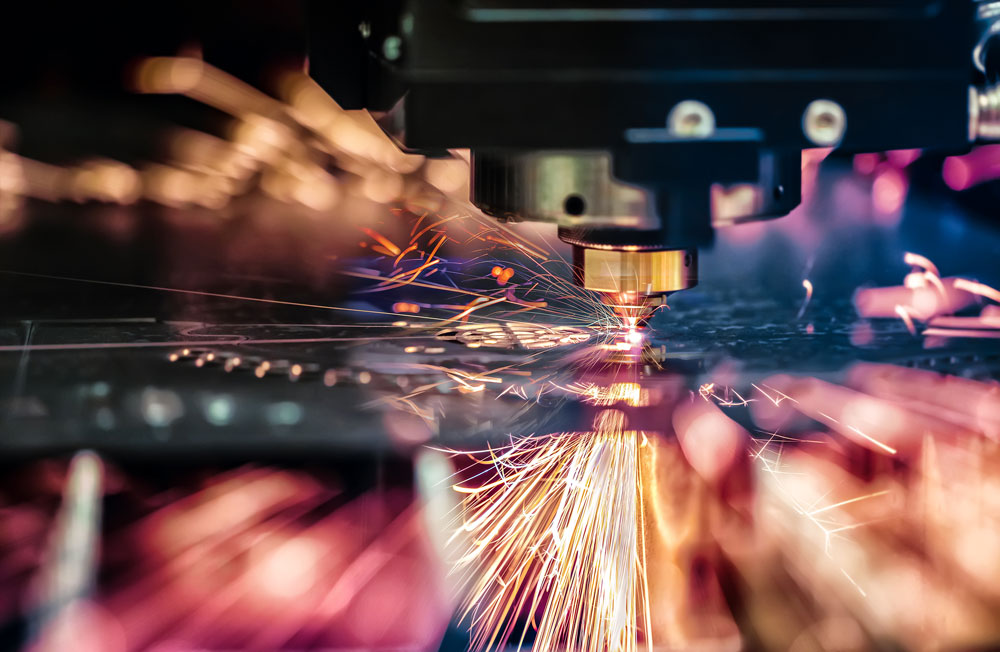
Every laser cutting installation has a UPS in front of it. Most specifications say so explicitly.
So when laser sources degrade, power supply modules fail and service calls rise inside the warranty period, power is the first thing ruled out and the last thing examined. A UPS was installed. The supply never failed. The fault must be the machine.
That single assumption moves the cost onto whoever built the machine.
The attribution problem
The commercial issue with laser cutting installations is not that failures happen. It is where they get attributed.
Because a UPS is present, failures are attributed to:
- Machine design
- Component quality
- Manufacturing tolerance
They are rarely attributed to the electrical environment the machine operates in, because nobody logged an electrical event.
The consequence is direct. During warranty the OEM absorbs replacement parts, field service visits and downtime escalation for a failure mode it did not create. After warranty the end user absorbs it and forms a view about machine reliability that follows the brand.
Why laser cutting is electrically hostile to its own supply
Laser cutting systems are non-linear, high-surge, harmonic-generating loads. They draw current in sharp pulses rather than smooth sine waves and feed harmonics back into the supply that serves them.
During real cutting operation, high-intensity demand occurs in rapid succession with a steep rate of current rise. Load current overshoots repeatedly, jolting the power delivering capability of the UPS and demanding an instantaneous energy response.
The machine is therefore both the victim of the distorted supply and a contributor to it.
What the UPS is allowed to do, and why that matters commercially
International norms permit a momentary distortion in the output power waveform and a nominal dip in output voltage during these events, corrected within the next power cycle. IEC and UL allow a voltage dip of ±5% for 10ms during very high surge current events.
A conventional industrial UPS follows that guideline. It is compliant while doing it. No alarm is raised and no event is recorded.
| Compliance therefore removes the UPS from suspicion without removing the exposure from the machine. |
The full technical background is in the industrial UPS guide. Click here
Where the cost lands
| During warranty | After warranty | |
| Laser source and optics replacement | OEM | End user |
| Power supply and control module failure | OEM | End user |
| Field service and travel | OEM | End user or AMC |
| Production downtime | End user | End user |
| Reliability perception | OEM brand | OEM brand |
Note the last row. It does not move. The party that pays for the parts changes at the end of warranty, but the reputational cost stays with the machine builder in both columns.
Why specifying a UPS is not a defence
The specification usually says a UPS of a given kVA rating with online double conversion topology. That specification addresses backup, voltage regulation and isolation.
It does not address:
- Behaviour under repetitive steep-rising current overshoot
- Whether crest clipping is permitted at peak demand
- THD behaviour across cyclic operation
- Output derating under harmonic load
Because none of that is specified, none of it is verified, and a compliant system that permits the standard-allowed distortion satisfies the specification completely.
What changes when waveform integrity is engineered in
The ARVI approach came out of detailed power audits across laser cutting and CNC installations rather than from a standards document.
The ARVI HSP platform uses DVI, Dynamically Varying Impedance, a proprietary topology that continuously senses load current and dynamically varies output impedance in real time. What that produces at the output is CPD, Crest Power Delivery: a clean, undistorted waveform maintained through repetitive peak demand.
In a laser installation:
- High inrush and repetitive peak surge handled without output voltage dip
- Crest clipping prevented, THD kept under control
- No harmonic derating
- Laser power supplies and control electronics not repeatedly stressed by distorted input
The commercial effect follows the engineering one. Fewer power-driven failures inside warranty means fewer parts absorbed, fewer service visits and fewer reliability conversations that the machine builder cannot win.
The same electrical behaviour affects machining centres on the same floor. See UPS for CNC machines. [link: /ups-for-cnc-machines/]
What to ask before the machine ships
For OEMs specifying the power infrastructure alongside the machine, and for buyers commissioning one:
- Does the proposed UPS permit the standard-allowed voltage dip and waveform distortion under surge?
- Has the supplier measured the machine actual surge behaviour, or sized from nameplate rating?
- Can output waveform stability be demonstrated under load before dispatch?
- Who is contractually responsible if failures are later traced to power quality?
- Is the power infrastructure being selected on suitability or on availability?
Frequently asked questions
A UPS guarantees supply continuity. It does not automatically guarantee waveform integrity during high surge. Conventional systems are permitted to allow momentary distortion and voltage dip at peak demand, and the cumulative effect of that exposure influences the service life of sensitive components.
It is difficult, because the damage is cumulative and no single event is recorded. Diagnosis is more reliable through measurement of the live electrical environment under real cutting conditions than through post-failure analysis.
ARVI engineers will measure what your laser installation is actually receiving under cutting conditions and identify power-driven failure exposure before it becomes a warranty claim.