


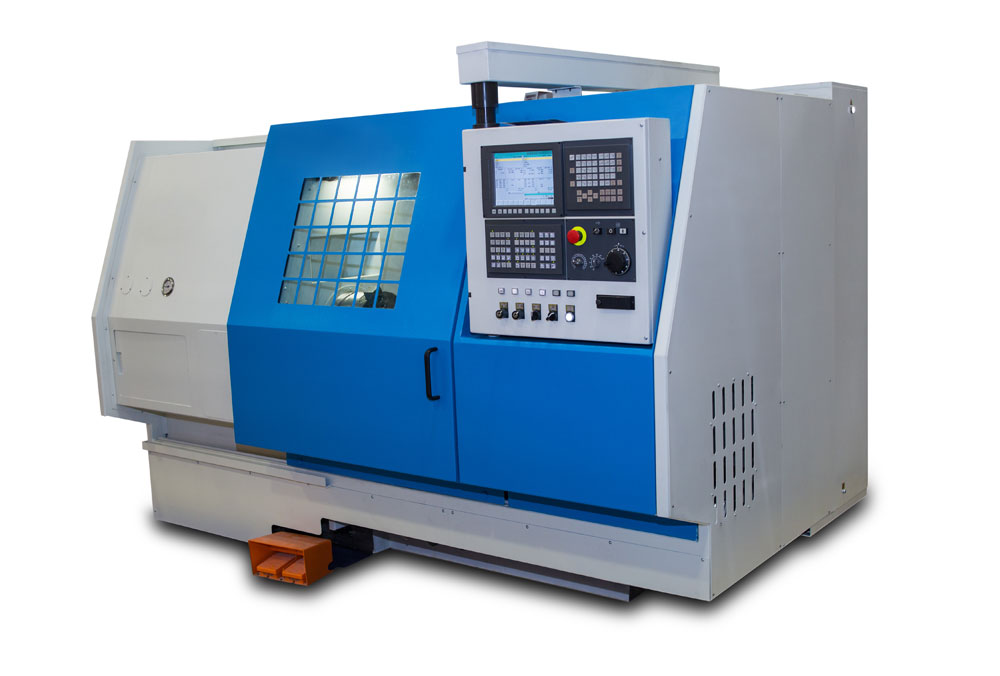
A standard industrial-grade UPS for CNC machines are designed to perform reliably under normal operating conditions and can also handle conventional surge and peak power demands and may save a few thousands at the point of purchase. However, under high crest-factor, repetitive peak-load applications often associated with CNC machine centers—where the load current rises almost instantaneously from its average operating current to its peak value, with a near-vertical rate of rise on the current waveform—the demand placed on the UPS is fundamentally different.
During these extremely steep current transitions, the UPS is required to respond within microseconds while maintaining a clean and stable output waveform. A conventional industrial UPS, are not specifically engineered for this type of load behavior, and will be unable to maintain output power integrity under these conditions. The output waveform becomes distorted during every repetitive peak-current event, and this distorted power is continuously delivered to the connected CNC machine. The UPS distorts under peak demand as it was not engineered to handle this crest power loading, and that distorted power feeds continuously into the power supplies and sensitive components of the connected equipment.
The damage is not sudden. It is cumulative. The equipment fails to perform to its designed optimum, falls short of its intended product life, and the lakhs committed to the machinery and infrastructure are quietly put at risk. The connected loads and equipment reaches end of life well before its designed life. The cost of ownership per year climbs. And in the end, you lose lakhs of rupees trying to save a few thousands.
Step one: read the pattern, not the individual fault
Before looking at the UPS, look at when faults cluster. The pattern that points to power quality rather than machine condition:
- Faults concentrate during heavy cutting cycles, rapid traverse or spindle acceleration, not during idle or setup
- Multiple machines on the same supply show unrelated symptoms in the same period
- Replacing the suspected component restores normal operation for a while, then the failure returns
- Drives report undervoltage or DC bus faults with no corresponding supply event logged
- Accuracy drifts progressively rather than failing outright
Individually each of these reads as a machine issue. Together they describe an electrical environment problem.
Step two: what a CNC machine does to its own supply
CNC machines are not steady loads. Spindle acceleration, rapid axis reversal, servo braking and tool changes create sharply non-linear current demand with a very steep rate of rise, known as high di/dt.
During those operations, load current overshoots repeatedly and in rapid succession. Each overshoot jolts the power delivering capability of the UPS and demands an instantaneous energy response within that cycle.
Machining is not a single event of this kind. It is millions of them across a production life.
Step three: what the UPS is permitted to do about it
This is where the diagnosis usually stops too early, because the UPS is behaving correctly.
To absorb a jolt of this kind, the guideline recommended under international norms allows a momentary distortion in the output power waveform and a nominal dip in the output voltage, on the condition that it is corrected within the next power cycle. IEC and UL permit a voltage dip of ±5% for 10ms during very high surge current events.
A conventional industrial UPS therefore allows exactly that during high-intensity, rapid-cyclic operation. It is compliant. It logs nothing. There is nothing for a service engineer to find.
The full explanation of that allowance sits in the industrial UPS guide. [link: /ups-for-industrial-applications/]
Step four: what actually reaches the machine
At each overshoot the machine sees:
- A momentary dip in supply voltage
- Clipping at the crest of the waveform
- A rise in THD
Individually the distortion is extremely small. The engineering concern is not magnitude. It is the cumulative effect of millions of such repetitive electrical events over the operating life of the equipment, which influences the long-term performance, reliability and service life of the connected machinery.
Drive power supplies, capacitors, breakers, switchgear and control modules are exposed to that input continuously and begin treating a distorted waveform as normal.
Step five: why root cause analysis misses it
Because the effects are not immediately visible, the root cause of a CNC power supply failure or a progressive accuracy problem is rarely traced back to power quality.
The investigation runs into three dead ends:
- There was no outage, so the supply is cleared
- The UPS was online and within specification, so the UPS is cleared
- The failed component is replaced, which resolves the symptom and closes the investigation
The electrical environment is never examined, so the exposure continues.
What a CNC-suitable UPS has to do differently
Conventional UPS systems operate with a relatively fixed output response. They are designed around an assumed load profile and hold that response while the load changes underneath them. A CNC load changes constantly.
At the core of the ARVI HSP UPS is a proprietary technology called DVI, Dynamically Varying Impedance. The HSP model continuously senses load current and dynamically varies its output impedance in real time, using a proprietary switching topology combined with specially designed magnetics. Rather than holding a fixed response and permitting the distortion, it tracks the load behaviour as it happens.
The result is CPD, Crest Power Delivery: the ability to maintain premium-grade power quality and a clean, undistorted output waveform even during repetitive peak demand and real load stress.
For a CNC installation that means:
- High inrush and repetitive peak demand handled without output voltage dip
- No crest clipping and no waveform distortion, with THD held under control
- No harmonic derating
- Drive and control power supplies not chronically stressed by distorted input
DVI and CPD are default capabilities of ARVI industrial UPS platforms, not optional modules.
Laser cutting systems on the same shop floor create a related but harsher version of this problem. See UPS for laser cutting machines. [link: /ups-for-laser-cutting-machines/] Servo-driven machines that regenerate during deceleration add a second failure mode covered in UPS for regenerative loads. [link: /ups-for-regenerative-loads/]
Questions to ask before specifying a UPS for CNC
- How does the system behave during repetitive steep-rising current overshoot, not steady state?
- Does it permit the standard-allowed voltage dip and waveform distortion during surge, or engineer around it?
- Is there output derating under harmonic load?
- Has the supplier analysed your actual load profile, or applied a kVA rule of thumb?
- Can performance be demonstrated under load before dispatch?
Frequently asked questions
Because the trip is usually a response to supply quality rather than supply loss. During rapid acceleration or heavy cutting, current overshoots sharply and a conventional UPS is permitted to allow a momentary voltage dip and waveform distortion in response. The drive sees an unstable input and protects itself.
Repeated exposure to a distorted waveform affects the stability of drive and control power supplies. Because degradation is cumulative rather than sudden, it typically presents as progressive drift rather than an outright fault.
Share your machine list and load profile. ARVI engineers will evaluate how your CNC installation behaves electrically under real cutting conditions and what your current UPS is permitting.